MAGHAKYAN BOTANIC
Maghakyan Botanic
Services
Professional landscaping is much more than planting greenery. A successful green space should be attractive, functional, climate-appropriate and manageable over the long term. Trees, shrubs, perennials, lawn and irrigation should work together as one coordinated system.
Our Landscaping and Greening service is designed for private homes, courtyards, restaurants, hotels, office complexes and public spaces. Each site is approached individually according to its size, sun and shade conditions, soil, water quality, terrain, climate, architecture and the client’s expectations.
The goal is not to fill the site with as many plants as possible, but to create a healthy, balanced and sustainable planting system that will continue to develop well over time.
An attractive plant is not automatically the right choice for every site. Heat, frost, wind, alkaline soil and irrigation water quality can all affect plant performance. Poor selection often leads to higher maintenance costs and plant loss.
Professional landscaping begins with understanding site conditions and selecting species that can thrive reliably in that environment.
Before planting begins, the site is assessed for terrain, sun and shade, wind exposure, soil structure and water availability. Soil pH and irrigation water quality may also be evaluated where necessary.
This is particularly important in Armenia, where the Ararat Valley, Yerevan, Sevan, Dilijan and higher-altitude areas have significantly different growing conditions.
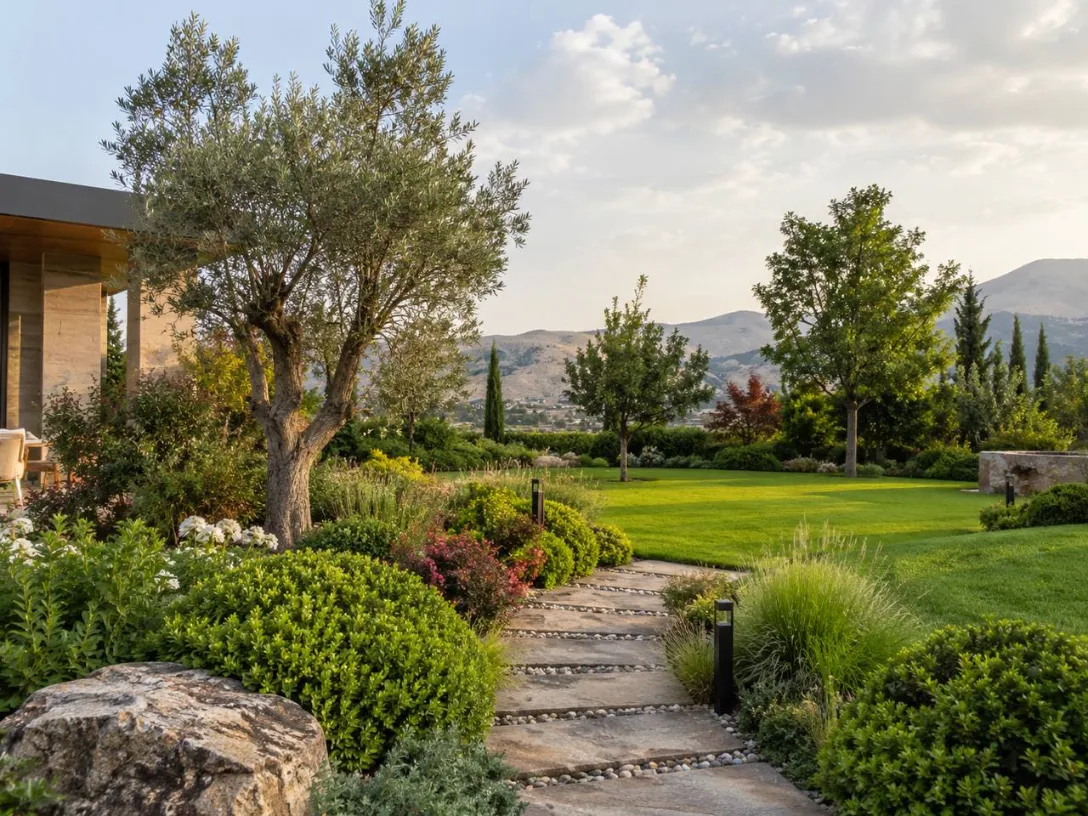
Trees create the main structure of a landscape, providing shade, height and long-term visual impact. Mature height, canopy width, root development and distance from buildings and paths are all considered before planting.
For large specimen trees, planting-pit preparation, root-ball protection, anchoring and post-planting irrigation are especially important.
Shrubs and perennials bring volume, color and seasonal interest. Plants are selected so that the landscape remains visually engaging throughout the year, with evergreens helping maintain structure in winter.
A high-quality lawn requires proper soil preparation, grading, suitable seed or sod, uniform irrigation and regular maintenance. Lawn is best used where it has a practical purpose such as recreation, play or open visual space.
Where water conservation or lower maintenance is important, parts of the lawn can be replaced with groundcovers, gravel, mulch or ornamental planting.
Different plant groups have different water requirements. Drip irrigation is commonly used for trees, shrubs, hedges and planting beds, while sprinkler or rotor systems are more suitable for lawns.
Automation improves water efficiency and reduces the risk of inconsistent manual watering.
Even high-quality plants cannot thrive in unsuitable soil. Heavy clay soils may require improved structure and drainage, while sandy soils may need more organic matter and moisture retention.
Hedges can provide privacy, divide functional areas, reduce wind exposure and define the structure of a landscape. Proper spacing helps create density without excessive competition between plants.
Planting compositions may combine evergreens, flowering shrubs, ornamental grasses, perennials, natural stone and gravel. A strong composition considers plant form and color throughout the seasons, not only at the time of installation.
Mulch and gravel help reduce soil moisture loss, limit weed growth and maintain a clean visual finish around planting areas.
Existing gardens do not always require complete replacement. Valuable mature plants can often be retained while selected plants are relocated, planting beds are redesigned, lawns are restored and irrigation is upgraded.
For restaurants, hotels, offices and other commercial sites, landscaping is part of the customer experience and brand image. Entrances, terraces, seating areas and photo zones can be planted to create a memorable, professional environment.
Private gardens should reflect the lifestyle of the household. Children, pets, pools, outdoor dining and edible gardens all influence plant selection and site organization.
A successful garden should be both attractive and practical for everyday use.
Good landscaping is planned for years rather than for the first season. Mature plant size, growth rate, seasonal interest and long-term maintenance are all considered.
The first months after planting are especially important for establishment. Irrigation, nutrition, pests, pruning and soil condition should be monitored closely. Regular professional care helps protect the initial investment and prevent early problems.
Professional landscaping combines plant biology, design and technical systems. Each plant is given the right location, appropriate conditions and a clear role within the overall composition.
Landscaping is an investment in the beauty, comfort and value of a property. Appropriate plants, high-quality installation, efficient irrigation and long-term care create a living environment that improves with time.