MAGHAKYAN BOTANIC
Maghakyan Botanic
Services
Healthy, sustainable landscaping depends heavily on a properly designed irrigation system. Even high-quality plants and good soil cannot perform consistently if watering is irregular, excessive or insufficient.
Our Drip Irrigation service is designed for trees, shrubs, hedges, flower beds, ornamental planting schemes, edible gardens and other planted areas. Water is delivered directly to the root zone in small, controlled amounts.
A professional system is designed around the specific site, taking into account plant species, soil structure, terrain, water pressure, water quality and the requirements of individual irrigation zones.
Drip irrigation is a watering method that delivers water slowly and directly to the active root zone. Unlike broad surface watering, it targets the areas where plants can use moisture most effectively.
A system may include main pipes, distribution lines, drip tubing, individual emitters, filters, pressure regulators, valves and an automatic irrigation controller.
Drip systems are particularly suitable for ornamental trees and shrubs, hedges, roses, perennial beds, hydrangeas, conifers, fruit trees, berry plants, vegetable gardens, greenhouses and commercial landscapes.
The best results are achieved when irrigation is considered during the landscape design stage. Plants can then be grouped according to their water requirements and each irrigation zone can be programmed accordingly.
This prevents one group of plants from being overwatered while another remains too dry.
Drip irrigation directs water where it is actually needed rather than onto paths, paving or unused areas. This is especially valuable on larger landscapes where manual watering can consume significant water and labor.
Drip systems can be connected to automatic controllers that manage watering days, start times and zone duration. More advanced installations may also use rain or soil-moisture sensors.
Sandy soils allow water to move downward quickly, while clay soils absorb and spread moisture more slowly. Irrigation duration and frequency should therefore be adjusted according to soil structure.
Drip lines operate within a defined pressure range. Excessive pressure may damage components or cause uneven output, while insufficient pressure may leave distant areas under-watered.
Pressure regulators and separate irrigation sectors are used where necessary.
Emitter clogging is one of the most common technical problems in drip irrigation. Sand, mineral deposits, salts and suspended particles can block small outlets.
For this reason, filtration is an essential part of a reliable system, and the filter type should be selected according to the water source and quality.
During the first years after planting, water should be concentrated around the developing root zone. As the tree matures, the irrigated area should gradually expand, which may require repositioning emitters or drip lines.
Mulch reduces soil overheating and evaporation, making it an excellent complement to drip irrigation. Together they help maintain more stable moisture around plant roots.
Some drip systems can deliver water-soluble fertilizers through the irrigation network. This process, known as fertigation, can be highly effective but requires accurate dosing and compatibility checks to prevent root damage or salt buildup.
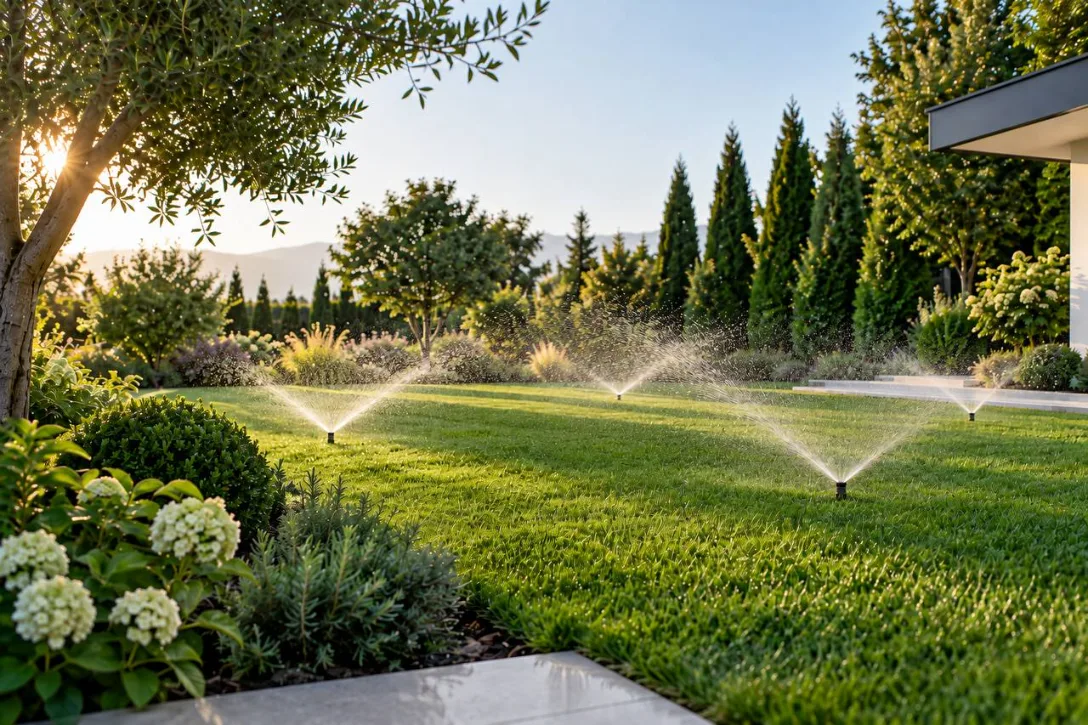
Lawns generally require sprinkler or rotor irrigation for even surface coverage. Many modern gardens therefore use a combined system: drip irrigation for planting areas and sprinklers for turf.
An irrigation system requires periodic inspection. Emitters, filters, pressure and possible leaks should be checked during the season. Watering schedules may also need adjustment as plants mature or weather conditions change.
A professionally designed system treats irrigation as part of the entire landscape rather than as a separate technical element. Plant requirements, soil, water supply and maintenance are planned together.
This reduces the risk of water waste, overwatering, drought stress and root problems.
Drip Irrigation is an essential part of efficient modern landscaping. It delivers water directly to the root zone, supports automation and allows different watering schedules for different groups of plants.
When designed for the specific site and maintained properly, a drip irrigation system becomes a long-term investment in the health and stability of the landscape.