MAGHAKYAN BOTANIC
Maghakyan Botanic
Plants
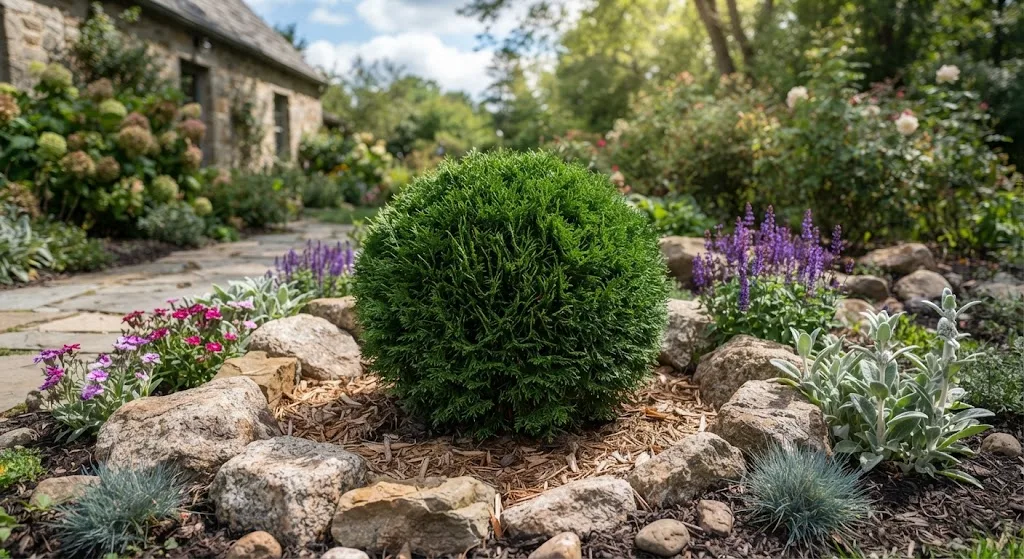
Thuja occidentalis ‘Danica’ is a slow-growing dwarf cultivar of American arborvitae with a naturally dense, rounded habit. This evergreen conifer forms a compact, symmetrical globe and generally needs little formal pruning to maintain its shape. Because of its modest size, ‘Danica’ is an excellent choice for small gardens, borders, rock gardens, entrance areas, mixed planting schemes and container landscaping.
The cultivar is valued for its fine, scale-like evergreen foliage and neat appearance throughout the year. In winter, the foliage may develop a slight bronze tone, which is a normal seasonal response. In landscape design, globe arborvitae ‘Danica’ is frequently used as a structural accent in formal, contemporary and minimalist planting schemes.
Thuja occidentalis ‘Danica’ performs best in full sun or light partial shade. For a dense and evenly rounded crown, provide approximately 4–6 hours or more of direct sunlight per day. Good light helps keep the foliage compact and supports the cultivar’s naturally spherical form.
In deep shade, plants may become loose, less symmetrical and slower growing. In regions with very hot summers, newly planted specimens can benefit from limited protection from intense afternoon sun, particularly when irrigation is not completely consistent.
During the first years after planting, ‘Danica’ arborvitae requires regular, carefully managed watering. The soil should remain moderately moist but never continuously waterlogged. The root ball of a newly planted shrub should not be allowed to dry out for long periods, as drought stress may cause yellowing or browning of the foliage and dieback of small shoots.
Once established, the plant becomes more resilient, but deep watering is still important during prolonged hot and dry weather. Less frequent, thorough irrigation is generally better than frequent shallow watering because it encourages a stronger root system. Drip irrigation is a practical solution for grouped plantings.
‘Danica’ is considered a cold-hardy cultivar and performs well through cold winters when properly planted and maintained. It does not require high atmospheric humidity, although the combination of dry air, hot wind and dry soil can stress the foliage.
Young shrubs should be protected from severe drying winter winds where exposure is intense. In areas that receive heavy, wet snow, excess snow should be gently removed from the crown to prevent the rounded structure from opening or becoming distorted.
Globe arborvitae grows best in fertile, well-drained, moderately moist soil with a light to medium texture. In heavy or poorly drained soils, improving drainage is especially important because prolonged waterlogging can damage the roots. At planting time, the soil may be amended with mature compost or good-quality organic matter.
A balanced fertilizer formulated for conifers can be applied in spring at a moderate rate. Excessive nitrogen should be avoided because it may encourage soft, excessive growth and reduce the plant’s naturally compact character. Organic mulch around the root zone helps conserve soil moisture, moderate soil temperature and suppress weeds.
Thuja ‘Danica’ normally requires very little formative pruning. In spring, remove dry, damaged or discolored shoots and lightly trim only if necessary to refine the outline. Because the foliage is dense, removing dry material from inside the shrub can improve air circulation and reduce conditions favorable to disease.
Allow adequate spacing between plants based on their mature spread. Do not bury the root collar during planting, and avoid piling mulch directly against the stems. Inspect plants periodically for spider mites, scale insects and signs of fungal problems. With suitable light, consistent irrigation and moderate fertilization, Thuja occidentalis ‘Danica’ maintains its compact, rounded habit for many years and remains a dependable evergreen for borders, rock gardens, small landscapes and modern garden design.