MAGHAKYAN BOTANIC
Maghakyan Botanic
Plants
General Information
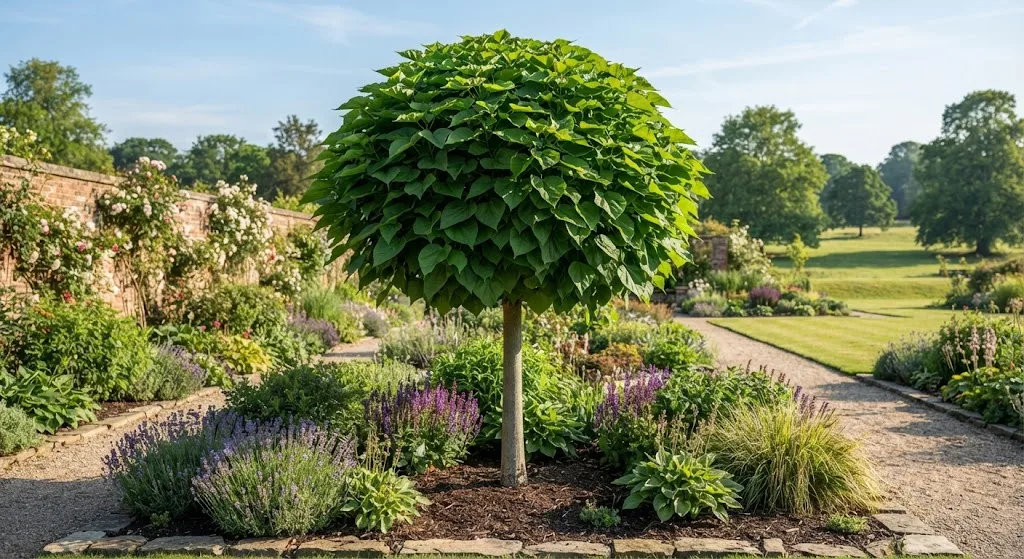
Globe catalpa (Catalpa bignonioides ‘Nana’) is a highly ornamental deciduous tree valued for its naturally compact, rounded crown. It is commonly grafted onto a straight standard trunk, creating a dense globe-shaped canopy that usually requires very little formative pruning. Its large, heart-shaped, bright green leaves give the tree a lush and architectural appearance while providing pleasant summer shade. Unlike the typical species, the ‘Nana’ cultivar generally does not flower, or flowers only rarely, so its primary ornamental features are its foliage and symmetrical crown.
Globe catalpa is widely used in landscape design, urban landscaping, courtyards, entrance areas, parks and smaller gardens. Its balanced shape makes it effective as a specimen tree, in rows along paths, or in symmetrical planting schemes where a clean and structured appearance is desired.
Light Requirements
Globe catalpa performs best in full sun. A site receiving at least 6 hours of direct sunlight per day helps maintain dense foliage, an even crown and healthy annual growth. Good light also supports stronger shoots and a more attractive overall shape.
Light partial shade is tolerated, but prolonged shade can make the canopy thinner and less symmetrical. Young trees benefit from an open position that is reasonably protected from persistent strong winds.
Watering
During the first one to two years after planting, regular deep watering is important for successful root establishment. The soil should remain moderately moist without becoming permanently saturated. During hot, dry periods, irrigation frequency should be increased, particularly for newly planted trees.
Deep, less frequent watering is preferable to frequent shallow watering because it encourages deeper root development. Applying organic mulch around the root zone helps reduce evaporation, stabilize soil moisture and protect roots from excessive summer heat.
Temperature and Humidity
Catalpa bignonioides ‘Nana’ adapts well to temperate climates and established trees generally show good cold tolerance. Young specimens can be more sensitive to severe frost, drying winds and rapid temperature fluctuations during their first winters. Protecting the trunk and graft union can be useful in colder or exposed locations.
The tree tolerates summer heat reasonably well when adequate soil moisture is maintained. It has no special requirement for high atmospheric humidity, but persistently wet conditions combined with poor air circulation may encourage fungal problems.
Soil and Fertilization
Globe catalpa grows best in fertile, well-structured, well-drained soil with moderate moisture retention. It can adapt to a range of soil types, but heavy waterlogged ground or extremely poor soil may weaken root development and reduce canopy quality. Incorporating mature compost or well-rotted organic matter at planting can improve soil structure and fertility.
A balanced fertilizer for ornamental trees may be applied in spring. Excessive nitrogen should be avoided because it can produce overly soft, elongated growth. From late summer onward, nitrogen feeding should be reduced and balanced potassium and phosphorus nutrition may be favored to support stronger tissues.
Important Care Tips
One of the main advantages of the ‘Nana’ cultivar is that its crown naturally remains rounded, so intensive shaping is rarely necessary. Pruning is mainly limited to removing dead, damaged, diseased or crossing branches during dormancy or early spring. Any vigorous shoots emerging below the graft union should be removed promptly.
When planting, allow sufficient space for the mature width of the crown and avoid positioning the tree too close to buildings or narrow walkways. Young standard trees are best supported with a stake until their root system is secure, especially in windy sites. Inspect the foliage regularly for pests or disease symptoms and address problems early.
With the right location, consistent watering and balanced care, globe catalpa retains its neat architectural form for many years and becomes a strong focal point in both private gardens and urban landscape projects.