MAGHAKYAN BOTANIC
Maghakyan Botanic
Blog
Landscape design today is far more than simply choosing attractive plants or decorating an outdoor space. Modern landscaping combines aesthetics, plant biology, functionality, climate conditions, irrigation planning and long-term maintenance requirements.
This approach is particularly important in Armenia. Climatic conditions vary significantly across different regions of the country, while in Yerevan and the Ararat Valley, high summer temperatures, dry air and the need for efficient water use directly influence landscaping decisions.
As a result, one of the key trends in modern landscape design in Armenia is shifting from simply creating a “beautiful garden” toward developing a sustainable, long-lasting outdoor environment that is carefully adapted to the specific site.
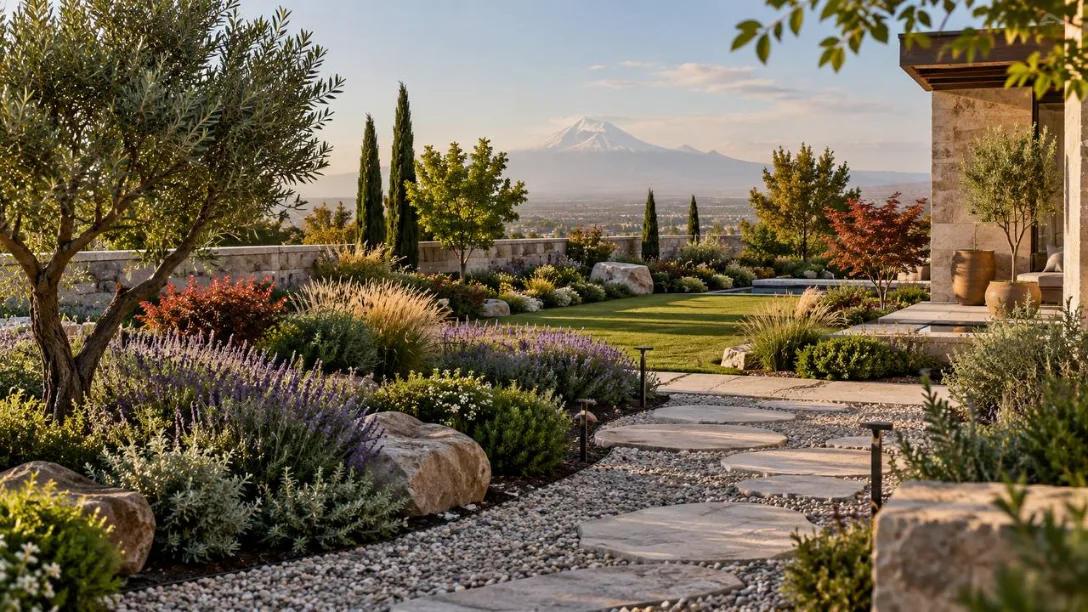
In recent years, overly formal, highly symmetrical and artificially structured gardens have gradually become less dominant in landscape design. They are increasingly being replaced by more natural-looking compositions in which plants appear to have developed organically over time.
These gardens combine trees of different heights, ornamental shrubs, perennial plants, groundcovers and ornamental grasses.
Instead of being planted in rigid rows, vegetation is arranged in layers, creating depth from tall trees down to lower-growing plants.
This approach works particularly well for private gardens, country houses, hotels, restaurants, recreation areas and larger properties.
A naturalistic style does not mean a lack of structure. In fact, it requires careful landscape planning so that plants maintain appropriate spacing as they mature and continue to form a harmonious composition over time.
One of the most important principles of modern landscape design in Armenia is selecting plants that are suitable for local climatic conditions.
Visual appeal alone is not enough. Professional plant selection should also consider winter hardiness, heat tolerance, drought tolerance, soil requirements, sun and shade conditions, susceptibility to pests and diseases, and mature plant size.
The same plant species may perform very differently across Armenia.
A plant that grows successfully in Yerevan may not necessarily perform equally well in Sevan, Dilijan, Gyumri or higher-altitude locations.
For this reason, professional landscape design should begin with a detailed site assessment rather than simply choosing plants from a catalogue.
The future of landscaping in Armenia is closely connected to responsible water management.
An irrigation system should ideally be considered during the initial landscape planning stage rather than installed only after planting has been completed.
Drip irrigation is particularly effective for trees, shrubs, hedges and planting beds because it delivers water directly to the root zone.
A properly designed automatic irrigation system also allows different sections of a garden to be watered according to the specific needs of each plant group.
The most effective approach is therefore to design planting zones and irrigation zones as one integrated system before installation begins.
Large lawns remain attractive and popular, but modern landscape design increasingly focuses on optimizing the amount of lawn used within a garden.
This shift is not purely aesthetic.
Lawns require regular irrigation, mowing, fertilization, aeration and plant protection measures.
For this reason, a more sustainable landscape design approach is to use lawn primarily in areas where it serves a practical purpose, such as children's play areas, open recreation spaces or seating zones.
Other areas can be landscaped with ornamental shrubs, perennials, ornamental grasses, groundcover plants, gravel and natural stone.
This creates a more layered and visually interesting garden that, when properly designed, can also be easier to maintain.
Miscanthus, Pennisetum, Festuca and other ornamental grasses have become key elements of contemporary garden design.
They add movement, texture and a natural character to outdoor spaces.
They are particularly attractive in the wind, when their foliage and flower heads create a dynamic, living landscape.
Ornamental grasses work beautifully with hydrangeas, junipers, barberries, lavender, flowering perennials and natural stone.
They are especially suitable for modern minimalist, naturalistic and Mediterranean-inspired landscapes.
In Armenia, garden owners often prefer evergreen plants because they want their outdoor spaces to remain green throughout winter.
However, modern landscape design generally benefits from a balanced combination of evergreen and deciduous plants.
Spruces, pines, junipers and Thuja maintain structure and greenery during winter, while deciduous trees and shrubs introduce seasonal interest through spring flowers, summer shade, autumn foliage and decorative fruits.
This balance allows the garden to remain attractive throughout the year rather than during only one season.
Another important trend in modern landscape design is focusing on composition rather than simply increasing the number of plant species.
Using too many unrelated plants can make a garden appear visually overloaded and can also make future maintenance more complicated.
Contemporary gardens often rely on a limited palette of carefully selected plant species that are repeated throughout the landscape.
Repeating the same ornamental grass, shrub or juniper in different areas helps establish visual continuity and gives the entire property a coherent identity.
This principle is particularly effective in smaller gardens and around contemporary architecture.
In contemporary landscape design, a garden is no longer treated simply as a green area surrounding a house.
Instead, it becomes an extension of the living environment.
A well-designed outdoor space may include several functional zones: a lounge area, outdoor dining space, children's play area, barbecue or fire-pit area, poolside zone, small productive garden, photo area or secluded relaxation corner.
Plants serve more than a decorative purpose in these spaces. They can define zones, provide shade, screen undesirable views and improve privacy.
This is why a comprehensive Landscape Design Project is essential. It allows functional zones, planting locations, pathways, irrigation systems, lighting and other landscape elements to be planned as one coordinated system.
Natural stone, timber, gravel and other natural or natural-looking materials are once again playing a major role in contemporary landscape design.
In Armenia, the use of local stone can be particularly effective because it helps connect the garden with the surrounding landscape and Armenian architectural character.
Stone can be incorporated into pathways, retaining walls, rock gardens, seating areas and planting compositions.
Modern design also emphasizes restraint.
A small number of carefully coordinated materials usually creates a more refined and premium appearance than using many different finishes within the same garden.
Vertical landscaping is becoming increasingly popular for smaller spaces and urban environments.
Green walls, structures covered with climbing plants and planted privacy screens make it possible to introduce additional greenery without requiring a large amount of ground space.
These solutions can be used in private residences, restaurants, cafés, offices, balconies and terraces.
In Armenia's climate, outdoor living walls require particularly careful plant selection and irrigation planning because both summer heat and winter temperatures can place significant stress on plants.
Lighting is an important component of modern garden design.
Well-planned lighting can completely transform the appearance of an outdoor space after sunset.
Rather than illuminating every plant, contemporary landscape lighting highlights selected trees, distinctive foliage, pathways, steps, water features or architectural elements.
Minimalism is important here as well.
The objective is not to make the garden as bright as possible, but to use light and shadow to create atmosphere, depth and visual interest.
Landscape lighting also improves safety and allows outdoor spaces to remain functional in the evening.
Biodiversity is becoming increasingly important in contemporary landscaping.
Instead of creating gardens dominated by only one or two plant species, landscape designers are incorporating a broader variety of trees, shrubs and perennial plants.
A carefully selected mix of vegetation can create a more resilient landscape while also providing a more supportive environment for birds and beneficial insects.
This approach is particularly valuable for large private properties, hotels, parks and public green spaces.
A successful garden should not only look beautiful immediately after installation.
A professionally designed landscape should continue to perform well five, ten or even more years later.
For this reason, maintenance requirements should be considered from the earliest design stage.
Before selecting a plant, it is important to understand its mature size, pruning requirements, water needs, response to local soil and climate conditions, and whether the property owner can provide the required level of care.
When these factors are overlooked, even landscapes containing expensive ornamental plants may lose their quality within a few years.
Modern lifestyles are also influencing landscape design.
Many property owners want an attractive green garden without having to spend large amounts of time on daily maintenance.
As a result, there is growing demand for low-maintenance landscaping solutions.
It is important to understand that a completely maintenance-free garden does not exist.
However, appropriate plant selection, automatic irrigation, mulching, well-planned planting schemes and timely professional garden maintenance can significantly reduce the amount of work required.
Modern landscape design in Armenia has the potential to develop a distinctive local identity when international trends are adapted rather than simply copied.
A contemporary Armenian garden can combine natural stone, large shade trees, evergreen plants, ornamental grasses, drought-tolerant shrubs and perennial planting.
The result can be modern while still reflecting the character of the Armenian landscape.
The goal should not be to use as many plants as possible, but to create a healthy, resilient and harmonious planting system.
Modern landscape design trends in Armenia are moving toward more natural, sustainable and carefully planned outdoor environments.
A successful contemporary garden should be functional, climate-responsive, water-efficient and manageable over the long term.
Good landscape design begins with a detailed analysis of the site — including sunlight and shade patterns, soil conditions, water quality and terrain — followed by appropriate plant selection, irrigation planning, landscape lighting and long-term maintenance.
When all these elements are considered as one integrated system, landscape design becomes more than simple landscaping. It becomes a long-term investment in the beauty, comfort and value of the property.