MAGHAKYAN BOTANIC
Maghakyan Botanic
Blog
Modern garden maintenance is difficult to imagine without a properly designed irrigation system. A beautiful landscape depends on much more than selecting attractive plants, preparing good soil and providing regular maintenance. Healthy plant development also requires water to be delivered at the right time, in the right quantity and exactly where plants can use it most effectively — in the root zone.
This is particularly important in Armenia, where summer conditions often include high temperatures, intense sunlight and prolonged dry periods. Under these conditions, efficient water use becomes one of the most important factors in maintaining a healthy and attractive garden.
For this reason, a drip irrigation system is not simply a convenient feature. It is an essential component of professional landscaping and modern garden design.
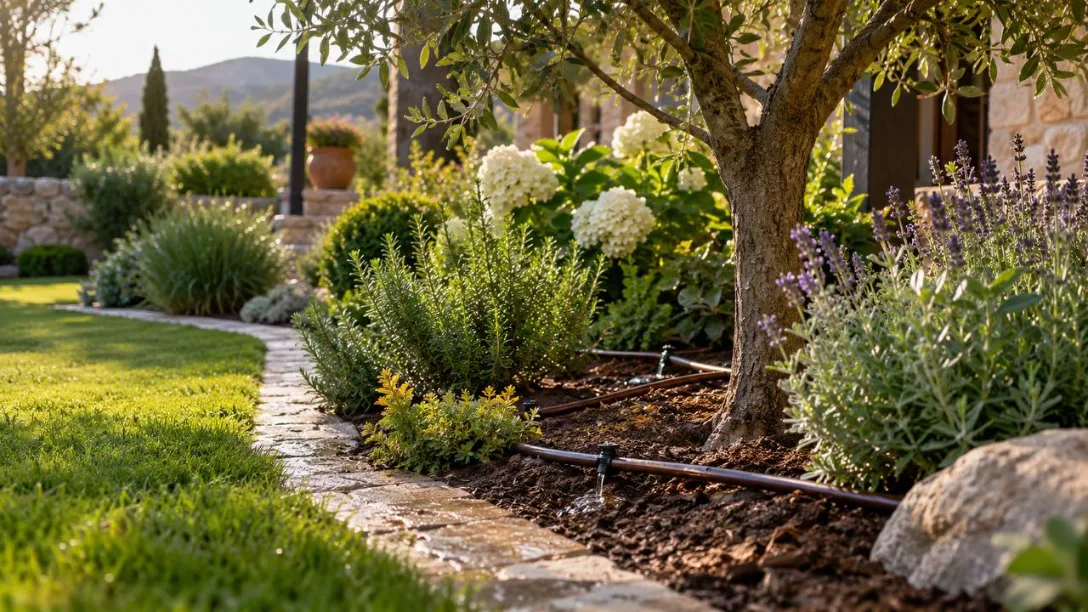
Drip irrigation is a method of watering in which water is delivered slowly and in controlled amounts directly to the root zone of plants.
Unlike conventional watering, where water is distributed over a large surface area, a drip irrigation system targets the specific areas where active roots are located.
A typical system may include:
A properly designed system can serve everything from a small private garden to a large landscaped property, orchard, hotel complex, restaurant garden, residential estate or public green space.
Many regions of Armenia experience hot and dry summers.
In Yerevan, the Ararat Valley and other lower-elevation areas, soil moisture can decrease quickly during summer. At the same time, an inefficient watering regime can lead not only to excessive water consumption but also to poor root development.
When plants repeatedly receive large amounts of water near the soil surface, their root systems may remain relatively shallow. These plants can become more vulnerable to heat and drought.
With drip irrigation, water is applied slowly and penetrates directly into the root zone. This can help maintain more stable soil moisture and provide better conditions for healthy plant growth.
One of the greatest advantages of a drip irrigation system is its efficient use of water.
With conventional watering methods, some water may evaporate, run onto paths or non-planted areas, or simply be used inefficiently.
Drip irrigation directs water toward the root zone. This can significantly reduce unnecessary water loss while still supplying plants with the moisture they need.
Water efficiency is especially important on larger landscaped sites, where manual watering can require substantial amounts of water and labor.
Plants absorb most of their water through their root systems. The purpose of effective irrigation is therefore not simply to wet the entire ground surface, but to maintain suitable moisture in the active root zone.
When drip lines are positioned correctly, water is delivered precisely where plants need it. This is particularly beneficial for trees, ornamental shrubs, roses, hedges, perennial plants and fruit crops.
Plants can be affected not only by a lack of water, but also by sharp fluctuations in soil moisture.
For example, when soil remains excessively dry for an extended period and is then suddenly saturated with a large amount of water, plants may experience stress.
A drip irrigation system allows water to be delivered in smaller, controlled amounts at regular intervals.
This makes it possible to maintain more stable soil moisture and adjust irrigation schedules according to plant requirements, soil type and weather conditions.
During hot weather, a considerable amount of water applied to the soil surface can quickly evaporate.
With drip irrigation, water flow is slower and concentrated in specific areas, helping to reduce evaporation losses.
Combining drip irrigation with mulching can make the system even more efficient. Mulch protects the soil surface from direct sunlight, reduces moisture loss and helps maintain a more stable environment around plant roots.
With drip irrigation, water is generally delivered to the soil rather than sprayed onto leaves.
This is an important advantage for many ornamental and agricultural plants.
Repeatedly wet foliage, especially in the evening or in densely planted areas, may create conditions that favor the development of certain fungal diseases.
Drip systems keep most of the moisture in the soil and around the roots.
When an entire soil surface is watered, moisture is also supplied to areas containing weed seeds.
A drip irrigation system primarily moistens the soil around the desired plants.
As a result, open areas between plants may remain drier, which can help reduce weed growth in some situations.
This does not eliminate weeds entirely, but a well-designed irrigation system can make overall garden maintenance easier.
Watering a large garden manually can be very time-consuming.
Hoses need to be moved, different areas must be monitored and someone must make sure that every plant receives enough water.
An automated drip irrigation system can operate according to a predefined schedule.
The garden owner or maintenance professional can control:
This is particularly useful for property owners who are not always present or who want to reduce daily manual maintenance.
In a professionally designed garden, not all plants require the same amount of water.
Certain ornamental shrubs may prefer moderate watering, while hydrangeas, some perennial plants and newly planted trees may require more consistent moisture.
For this reason, modern irrigation systems should ideally be divided into separate zones. Each zone can operate on its own watering schedule.
This helps prevent situations in which one group of plants is overwatered while another receives too little moisture.
The first few years after planting are particularly important for trees and shrubs.
During this period, the root system has not yet fully expanded into the surrounding soil, and the plant remains dependent on moisture within and around the planting area.
Drip irrigation allows water to be delivered in a controlled way directly to the developing root system.
As the plant grows, however, the position of emitters and the size of the irrigated zone should gradually be adjusted.
For mature trees, water should not continue to be delivered only directly beside the trunk.
For a modern garden, a professional Drip Irrigation service becomes even more effective when combined with automatic control.
An automated system can be programmed to manage:
More advanced systems may also use rain sensors, soil moisture sensors or weather-based controllers. This allows irrigation to become more precise, consistent and efficient.
Although drip irrigation has many advantages, it does not necessarily need to be the only watering method used throughout an entire garden.
For lawns, sprinkler or rotor irrigation systems are generally more suitable because they provide uniform coverage across the entire surface.
For trees, shrubs, flower beds, hedges, ornamental compositions and vegetable gardens, drip irrigation is often one of the most efficient solutions.
In contemporary landscape projects, the best results are frequently achieved by combining several irrigation methods.
Simply installing drip irrigation does not automatically mean that plants will be watered correctly.
Professional system design is essential.
Factors that should be considered include:
For example, water moves through sandy soil much more quickly than through clay soil.
As a result, the same irrigation duration can produce completely different results in different soil types.
One of the most common problems in drip irrigation systems is emitter blockage.
This may be caused by sand, mineral deposits, salts or other particles in the water.
For this reason, proper filtration is an essential part of a reliable system.
The appropriate type of filter depends on the water source and its quality. Water quality assessment is especially important when the irrigation supply comes from a well, storage reservoir or technical water system.
Drip irrigation lines are designed to operate within a specific pressure range.
Excessive pressure can damage the system or cause uneven water distribution. If pressure is too low, areas farther away from the water source may not receive sufficient water.
For larger or more complex landscapes, pressure regulators are therefore used and the irrigation system is divided into separate zones.
Even the best irrigation system needs to be used correctly.
During summer, early morning is often an effective time to irrigate because air temperatures are still relatively low.
This allows plants to make better use of the available moisture while reducing losses through evaporation.
Watering frequency should not be based solely on a fixed calendar. It should also depend on weather conditions, plant species, soil type and the stage of plant development.
Some drip irrigation systems can also be used to apply water-soluble fertilizers. This method is known as fertigation.
Its main advantage is that nutrients are delivered together with irrigation water directly to the root zone.
However, fertigation requires professional management, accurate dosing and careful evaluation of fertilizer compatibility.
Excessive or inappropriate fertilizer application can damage plant roots or increase soil salinity.
An irrigation system also requires periodic maintenance.
It is important to check:
A technical inspection at the beginning and end of the growing season can prevent many common problems.
In areas with cold winters, the irrigation system should also be properly prepared for winter conditions.
Several mistakes are commonly made when using drip irrigation systems.
One is applying the same irrigation schedule to every plant. Another is watering too frequently or for too long.
A further common mistake is keeping the drip line directly beside a tree trunk even after the tree has grown substantially.
Another problem is failing to inspect the irrigation system regularly. Plants grow, root systems expand and the original irrigation layout may eventually need to be modified.
Drip irrigation is particularly suitable for gardens that contain:
It is also highly beneficial in landscapes where efficient water use is a priority.
An irrigation system is sometimes viewed simply as an additional expense.
However, a properly designed drip irrigation system should be considered part of the long-term infrastructure of a garden.
Plants that receive the correct amount of water at appropriate intervals are generally better able to develop healthy root systems, tolerate stress and maintain their ornamental quality.
An automated system also reduces the need for manual watering and allows water to be used more efficiently.
In gardens containing valuable trees and ornamental plants, the absence of a reliable irrigation system can put the entire landscaping investment at risk.
A healthy and beautiful garden depends not only on selecting the right plants, but also on providing the right irrigation.
A drip irrigation system allows water to be delivered directly to the root zone, reduces unnecessary water loss, helps automate garden maintenance and makes it possible to create different watering programs for different plant groups.
For the best results, however, the system should be designed specifically for the site, taking into account climate, soil conditions, water quality, terrain, plant selection and long-term maintenance requirements.
When irrigation is planned from the very beginning of the landscape design process, it becomes an integral part of the garden's overall system and supports healthier, more sustainable and longer-lasting plant development.